
Reassessing Global Semi Overcapacity Risks: A 2027 Outlook
Semiconductor capacity is expanding at a pace the industry has rarely seen. From large-scale fab projects in the United States and Europe to continued investments across Asia, the global wafer and packaging footprint heading into 2027 looks very different from what it was just a few years ago.
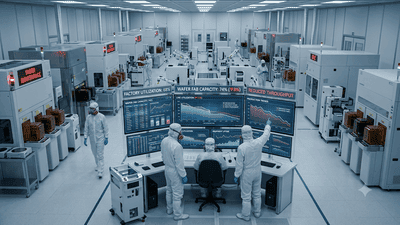
This article reassesses global semiconductor overcapacity risks with a 2027 outlook. It examines where capacity is growing, how demand is evolving, why “overcapacity” needs careful definition, and which segments—and companies—may be most exposed if supply outruns realistic consumption. It also offers practical ways investors, OEMs, and policymakers can monitor and mitigate capacity-related risk without overreacting to every new construction headline.
What “overcapacity” really means in semiconductors
Overcapacity is often used loosely to mean “too many fabs” or “too much supply.” In practice, the concept is more nuanced—and more sector-specific.
First, capacity is node-specific. Excess wafers at mature nodes do not automatically solve shortages at leading-edge nodes, and vice versa. Overcapacity must be assessed within each technological bucket: advanced logic, memory, analog, power, and specialty processes.
Second, capacity is geographically and functionally segmented. Front-end wafer capacity, back-end packaging, and test capacity are related but distinct. A surplus of wafers without matching advanced packaging or test capabilities can still feel like scarcity for system-level products.
Third, capacity must be evaluated against demand scenarios and utilization thresholds. A fab running consistently below, say, 70–75% utilization over time may indicate structural overcapacity in its segment, whereas occasional dips in utilization can be normal cyclical behavior.
In short, overcapacity is not a binary on/off condition; it is a mismatch between the quantities, technologies, locations, and timing of capacity on the one hand, and realistic, sustainable demand on the other.
Where capacity is expanding most into 2027

The risk of overcapacity must be judged against the pattern of current and planned expansion. Heading toward 2027, several broad trends stand out.
Advanced logic fabs in multiple regions. New leading-edge logic capacity is coming online or ramping in the US, parts of Europe, and existing Asian hubs. These projects are capital-intensive and often supported by industrial policy. Their focus is on nodes targeting AI accelerators, high-end CPUs/GPUs, and advanced communications silicon.
Mature-node expansions for automotive and industrial. Capacity for 28 nm and above—and related specialty processes—has been increasing to support automotive microcontrollers, powertrain controllers, industrial automation ICs, and long-lifecycle analog devices. Many of these projects aim to address vulnerabilities exposed during past shortages.
Memory investments with HBM emphasis. Memory suppliers are allocating capital to high-bandwidth memory and select DRAM/NAND mixes, while being more cautious in commodity DRAM. The concentration of investment in HBM-capable lines reflects AI-driven demand expectations but also raises the risk of swings if that demand slows.
Advanced packaging and test. Back-end capacity—particularly for 2.5D/3D packaging, chiplet integration, and high-density interconnects—is expanding in several regions. Packaging has been a bottleneck; investments aim to relieve that pressure. However, misalignment between front-end and back-end timing can create localized overcapacity.
Against this backdrop, overcapacity risk is not uniform. It depends on how each of these expansion waves line up with actual and expected demand by 2027.
Demand outlook: AI, electrification, and industrial cycles
To reassess overcapacity risk, we must consider the major demand drivers likely to shape 2027.
AI and high-performance compute. AI training and inference workloads have driven intense demand for leading-edge logic and high-bandwidth memory. If AI deployment continues to expand in cloud, enterprise, and edge environments, much of the new advanced-node and HBM capacity could be absorbed. If AI investment slows, becomes more efficient, or consolidates around fewer platforms, some capacity could run below intended utilization.
Automotive electrification and ADAS. The rise of electric vehicles, more sophisticated driver-assistance systems, and centralized vehicle architectures increases semiconductor content per vehicle—especially in power, analog, and controlled digital domains. This structural trend supports mature-node and power capacity, but actual utilization will depend on 2027 vehicle sales, regional adoption rates, and regulatory environments.
Industrial automation and energy transition. Factory automation, robotics, grid modernization, and renewable integration continue to add semi content to industrial systems. These trends help underpin demand for analog, power, and some digital control devices. Yet industrial capex cycles can still create slower patches; if investment pauses, some capacity could feel underutilized.
Consumer electronics and general compute. PCs, smartphones, and consumer devices remain significant but more mature markets. Content per device grows slowly, and refresh cycles are sensitive to macro conditions. Overcapacity risk is higher here if capacity expands on the assumption of strong, sustained unit growth that does not materialize.
Overall, demand into 2027 looks structurally stronger in automotive, power, and select industrial and AI segments, and more mixed in commodity compute and consumer categories. This divergence matters for where overcapacity is most likely to show up.
Segmentation of overcapacity risk by sector

With this demand context, we can outline where overcapacity risk appears most acute and where it is relatively contained.
Advanced logic for AI and HPC. If AI-related demand remains robust, leading-edge logic fabs may run at healthy utilizations. Overcapacity risk here is more about timing and concentration: if many advanced fabs ramp at once, and AI spending flattens or shifts, some sites could face margin pressure and lower-than-planned utilization.
Commodity memory. Historically, DRAM and NAND have been prone to overcapacity cycles. While suppliers are more disciplined today, the classic risk remains: if too many projects target commodity memory rather than differentiated products, 2027 could see price compression and underutilization in some lines.
Mature-node digital and consumer-focused analog. Expansions aimed at fixing past shortages may overshoot if consumer demand in PCs, smartphones, and lower-value devices does not keep pace. Capacity added for generic microcontrollers and standard analog parts could run below optimal utilization, especially if multiple regions duplicate similar capabilities.
Power and automotive analog. Overcapacity risk is relatively lower here, given strong structural demand from electrification and safety/regulatory requirements. However, if specific technologies (e.g., certain SiC generations) are overbuilt relative to EV adoption or policy timelines, localized overcapacity can emerge.
Advanced packaging. Back-end overcapacity is possible if packaging lines are built on expectations of front-end wafer demand that fail to materialize, or if too many facilities target the same high-end packaging niches. That said, packaging has been constrained, so some slack may be welcome before it becomes a genuine overcapacity problem.
Regional dynamics: policy-driven capacity and its risks
Industrial policies in multiple regions are explicitly driving new capacity, and those policies themselves color overcapacity risk.
Subsidy-backed fabs and political timelines. Projects motivated partly by subsidies and policy goals can be built even when pure market signals would be more cautious. This introduces the possibility that some capacity will exist because “it had to be built” rather than because demand necessarily justifies it by 2027.
Duplication of capability. When multiple regions aim for similar capabilities—such as mature automotive-grade capacity or mid-range nodes—there is a risk of duplication. If demand is not high enough globally to sustain all these sites at healthy utilizations, some regions may face overcapacity even as others operate comfortably.
Geopolitical hedging. Companies may accept lower utilization as the cost of geopolitical resilience—running multiple regional fabs so that supply is not concentrated. In this sense, what looks like overcapacity from a strict utilization standpoint may be an intentional buffer against policy or security shocks.
Thus, a 2027 outlook must consider not only economic utilization but also strategic and political rationales for capacity, which can keep overcapacity risks from manifesting purely as “excess supply” but still affect pricing and returns.
How overcapacity risks show up in financials

When overcapacity emerges, its effects typically appear in several financial dimensions for semiconductor companies.
Utilization and margins. Lower utilization spreads fixed costs across fewer wafers, compressing margins. Companies may respond by cutting prices, slowing capex, or consolidating production, but profitability can suffer in the interim.
Pricing pressure. Excess capacity in commoditized segments tends to trigger price competition. ASPs fall, and only firms with cost advantages or differentiated products can maintain margins.
Capex and depreciation burdens. Newly built fabs bring substantial depreciation costs. If revenue does not ramp as expected, these non-cash charges weigh on reported earnings and can spook investors.
Balance sheet strain. Companies that financed capacity aggressively may face tighter credit conditions or leverage metrics if returns do not meet expectations, limiting flexibility for future investments.
Into 2027, watchers of overcapacity risk should pay close attention to utilization commentary, pricing trends in specific segments, and adjustments in capex plans. These signals often reveal emerging mismatches before they fully materialize in headline profits.
Reassessing risk: what might mitigate overcapacity concerns
Overcapacity risk is real, but several factors may mitigate its severity in 2027.
Disciplined capex behavior. Many leading semi companies have become more cautious after past cycles, scaling investments in stages and tying capex more tightly to visible demand and long-term agreements, rather than purely speculative builds.
Flexible manufacturing and node repurposing. Some fabs are designed with flexibility to shift between nodes or product mixes. This adaptability can help absorb demand shifts and reduce the risk that a given line is “stranded” with no viable product options.
Continued structural demand growth. The combination of AI, electrification, industrial automation, and pervasiveness of electronics provides a broader and more diversified demand base than in earlier cycles. Even if one segment slows, others may help sustain capacity utilization.
Industry consolidation and cooperation. Mergers, partnerships, and long-term supply agreements can rationalize capacity over time, especially in segments prone to fragmentation and aggressive competition.
These mitigating factors do not eliminate overcapacity risk, but they make it less likely that the industry will face extreme, prolonged gluts in well-managed segments.
Practical monitoring framework for 2027
To reassess and monitor global overcapacity risks effectively, stakeholders can adopt a simple framework for 2027.
Track utilization by segment, not just globally. Separate leading-edge logic, commodity memory, automotive/industrial mature nodes, and advanced packaging when analyzing utilization data and commentary.
Watch pricing and order trends. Sustained price declines and weaker orders in a segment, even as capacity grows, are early warning signs of overcapacity. Conversely, stable pricing and strong backlogs suggest capacity is still tight.
Compare capex to realistic demand scenarios. Evaluate whether announced capex plans align with plausible demand growth in each segment under conservative, base, and optimistic scenarios.
Incorporate policy timelines. Consider when industrial-policy-backed capacity will actually ramp, and whether the corresponding demand drivers (AI, EVs, industrial projects) will be in phase or lagging.
Assess company-specific resilience. Firms with diverse product mixes, flexible fabs, strong balance sheets, and disciplined capex are better positioned to weather any overcapacity without severe damage.
Conclusion: overcapacity as a segmented, manageable risk
As the world approaches 2027 with a wave of new semiconductor capacity, reassessing overcapacity risk requires granular thinking. The danger is real in certain segments—commodity memory, generic mature-node digital, and potentially some duplicated regional capabilities—but less acute where structural demand growth, disciplined capex, and differentiated products dominate.
Rather than predicting a single global glut, the more grounded outlook is that overcapacity will emerge selectively, varying by node, geography, and product type. Companies and investors who treat capacity as a segmented, manageable risk—monitoring utilization, pricing, and capex alignment by sector—can navigate this environment with more confidence than those who rely on broad, undifferentiated “semi cycle” narratives. In a world where building fabs has become a tool of both industrial policy and corporate strategy, the challenge for 2027 is not to avoid capacity expansion, but to ensure it is aligned with realistic demand and supported by resilient business models.
You May Like

Narrowing Spread Between NAND Spot and Contract Prices in 2026 – A Signal
By 2026, one of the most watched metrics in the NAND flash market has started to shift in a subtle but meaningful way: the spread between spot prices and long‑term contract prices is narrowing. For casual observers, this may look like just another incremental change in a notoriously volatile industry. For memory makers, module houses, device OEMs, and data center buyers, however, a tightening gap between spot and contract prices is a signal—a reflection of evolving supply–demand balance, risk perceptions, and strategic behavior on both sides of the market.

Price Divergence Trading Strategies Between NAND Flash and DRAM ETFs
NAND flash and DRAM sit at the core of AI storage and computing power. Both are memory, but they are not the same business. DRAM is main memory—fast, volatile, and central to high‑bandwidth workloads like AI training and inference. NAND is non‑volatile storage—slower than DRAM, but crucial to persistent data and large‑scale object storage. The cycles that drive their pricing and margins overlap, yet they often diverge. That divergence is where trading strategies between NAND and DRAM ETFs become interesting.

China’s HBM Localization Progress: The Catch-Up Pace of CXMT and XMC
China’s drive to localize advanced memory technologies has accelerated over the past several years. High-Bandwidth Memory (HBM) sits near the center of that strategy because it is integral to AI accelerators, high-performance computing (HPC) and other strategic compute platforms. Two domestic players—ChangXin Memory Technologies (CXMT) and XMC (Xianghui Memory, commonly referred to as XMC)—have become focal points in assessing how quickly China can close the gap with international incumbents on HBM die, stacking, and packaging.

Thermal Simulation Challenges and Solutions in 3DIC AI Chip Design
As AI workloads push chips to deliver ever higher compute density, designers are increasingly turning to three‑dimensional integration (3DIC) to stack dies vertically and pack more functionality into limited footprints. While 3DIC architectures unlock significant performance and bandwidth advantages, they also introduce complex thermal behaviors that are far harder to predict and manage than in traditional 2D layouts.

An Attempt at Compiling a Memory+Compute Fusion Thematic Index – A Dual-Track Framework
Most AI investors talk about “compute” as if it were the whole story: GPUs, accelerators, chips, cores. But every one of those cores needs somewhere to read from and write to. Memory and storage define how wide the data highway really is. In practice, AI performance is a fusion of compute and memory, not a solo act. So why do so many indices and ETFs separate them into different silos—one for semiconductors, one for memory, one for data centers—when the actual workloads keep blending them?

Surging Demand for Laser Drilling and Plasma Dicing Equipment in Advanced Packaging
Advanced packaging has become one of the semiconductor industry’s most important growth engines, and it is now pulling a surprising set of process tools into the spotlight. Among the most in-demand are laser drilling and plasma dicing equipment. These machines sit close to the heart of heterogeneous integration, fan-out packaging, wafer thinning, TSV formation, glass substrate processing, and other advanced flows where precision, yield, and throughput matter enormously. As packaging moves from a back-end afterthought to a strategic platform, the equipment used to shape, open, and separate materials has become just as important as the dies themselves.
D2D Interface Bandwidth and Latency Comparison in Chiplet Architectures
Chiplet architecture has turned the package into a real performance battleground. Once multiple dies are placed side by side or stacked within the same advanced package, the quality of the die-to-die, or D2D, interface becomes one of the most important determinants of system behavior. Bandwidth is no longer a nice-to-have metric, and latency is no longer a small implementation detail. Together, they shape whether a chiplet system feels nearly monolithic or frustratingly fragmented.

Stock Selection Logic and Alpha Validation of ESG-Themed Semi ETFs
Semiconductor themed ETFs are no longer just about growth and cycles. A growing subset now layers environmental, social, and governance (ESG) criteria on top of traditional sector exposure. These ESG semi ETFs promise two things at once: access to one of the market’s most powerful secular themes, and alignment with sustainability and governance standards. The pitch is appealing, but it raises two hard questions. First, how exactly are these stocks being selected? Second, does the ESG overlay help, hurt, or leave alpha unchanged?